
Dust Collection Fan Static Pressure Calculation for Baghouse and Duct Systems
A dust collection fan static pressure calculation should include the complete resistance of the extraction system, not only the filter pressure drop. For baghouse collectors, cartridge dust collectors, welding fume extraction, woodworking dust collection, and metal grinding exhaust systems, the fan must overcome hood entry loss, duct friction, elbows, transitions, dampers, cyclone or spark arrestor loss, filter resistance, stack loss, and dust loading.
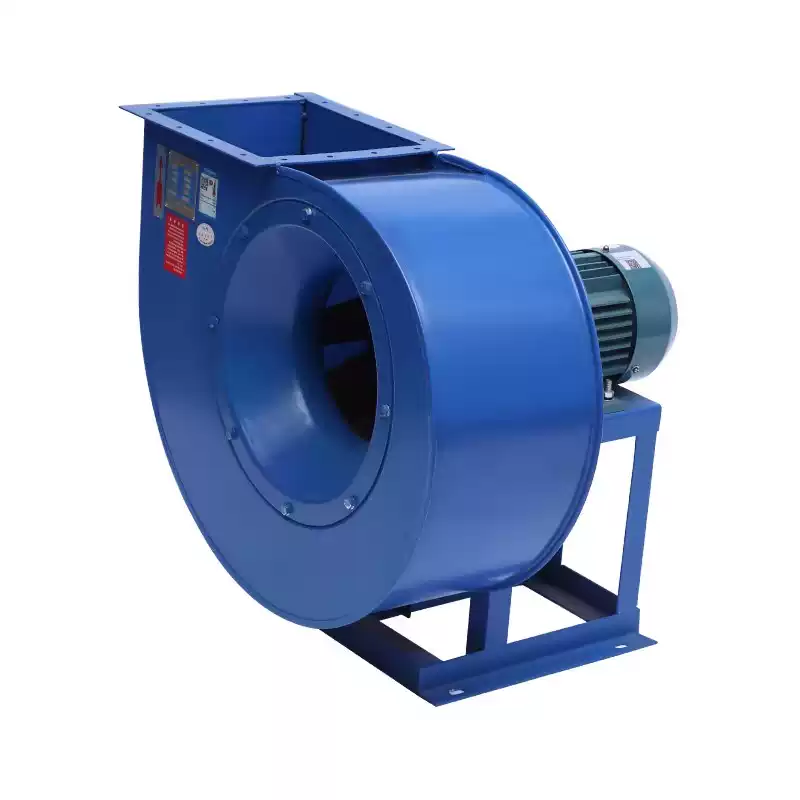
Correct pressure selection helps keep capture velocity stable at the hood, prevents dust escape, avoids overloading the motor, and gives the dust collector enough reserve as filters become loaded during operation.
Typical Applications
- Baghouse dust collector exhaust fan
- Cartridge filter dust collection fan
- Metal grinding and welding fume extraction
- Woodworking dust collection duct systems
- Cement, mineral, food powder, and chemical dust exhaust
- Scrubber or activated carbon pretreatment exhaust systems
Selection Parameters
| Parameter | Why It Matters |
|---|---|
| Required airflow at each pickup point | Determines capture velocity and total system volume. |
| Duct diameter and length | Controls conveying velocity and friction loss. |
| Number of elbows, branches, and transitions | Adds local resistance that is often underestimated. |
| Dust collector clean and loaded pressure drop | Fan should be checked at normal and loaded filter resistance. |
| Dust type and concentration | Affects wear resistance, impeller type, and explosion-proof needs. |
| Temperature, humidity, and corrosive gas | Impacts material selection and coating requirements. |
| Outlet stack or scrubber resistance | Must be added to the total external static pressure. |
Static Pressure Calculation Logic
The total static pressure is normally calculated as hood entry loss plus duct friction loss plus local fitting loss plus equipment resistance plus discharge loss plus operating margin. In many projects, the dust collector pressure drop changes during operation, so the fan should be checked against both clean-filter and loaded-filter conditions.
Common Selection Mistakes
- Using only baghouse pressure drop and ignoring duct loss
- Choosing low duct velocity and allowing dust settlement
- Ignoring elbows and branch balancing dampers
- Oversizing pressure and causing unnecessary power consumption
- Using a standard impeller where abrasive dust requires wear-resistant design
Practical Inquiry Checklist
- Total airflow and airflow at each hood
- Duct layout, diameter, length, elbows, and branches
- Dust collector type and clean/loaded pressure drop
- Dust type, concentration, particle size, and temperature
- Material requirement: carbon steel, stainless steel, FRP, wear-resistant plate, or coating
- Motor voltage, frequency, installation altitude, and control method
Related Reading
- Dust Collection Fan for Metal Grinding and Welding Fume Extraction
- Industrial Centrifugal Fan for Woodworking Dust Collection Systems
- Industrial Centrifugal Fan Selection for Wet Scrubber Exhaust Systems
FAQ
Is the dust collector pressure drop enough for fan selection?
No. The fan must also overcome hood entry loss, duct friction, elbows, dampers, branch loss, outlet resistance, and operating margin.
Should the fan be selected for clean filters or loaded filters?
Both conditions should be checked. Clean filters may create higher airflow, while loaded filters may require higher pressure to keep capture performance stable.
When is a wear-resistant fan required?
Wear-resistant construction should be considered when dust concentration is high, particles are abrasive, or the fan is installed before the dust collector.
